Climate
Bring your T-shirt for the south and woollens for the north.
Along with a changing landscape, the climate is bound to change too. But we organise our tours in seasons and landscapes that make your trip as pleasant as possible.
On the southern tours in the states of Kerala and Karnataka our routes are mostly in the hills, where the weather is comparable to an English summer. Temperature ranges from around 36ºC on the coast, to about 12ºC in the hills. The coastal areas are warm, muggy and sunny except during the rains when they cloud over.
When you ride in lush Goa, with the warm, fruity breeze tugging at your shirt, you may understand why the Portuguese who lived here for 400 years refused to leave, even after India got independence from the British in 1947. Finally, 14 years later, the Indian army entered Goa, and the possession of this ‘Portuguese Riviera’ returned to India.
Kings in Rajasthan built palaces in the middle of lakes, so the temperature inside the royal dwellings would be low. During the winter touring season, the average daily temperature here is a mild 28ºC. The night temperatures can drop as low as 4ºC in the desert.
India’s central plains can hit 50 degrees in summer. But you are not likely to encounter that, given our routes and schedules.
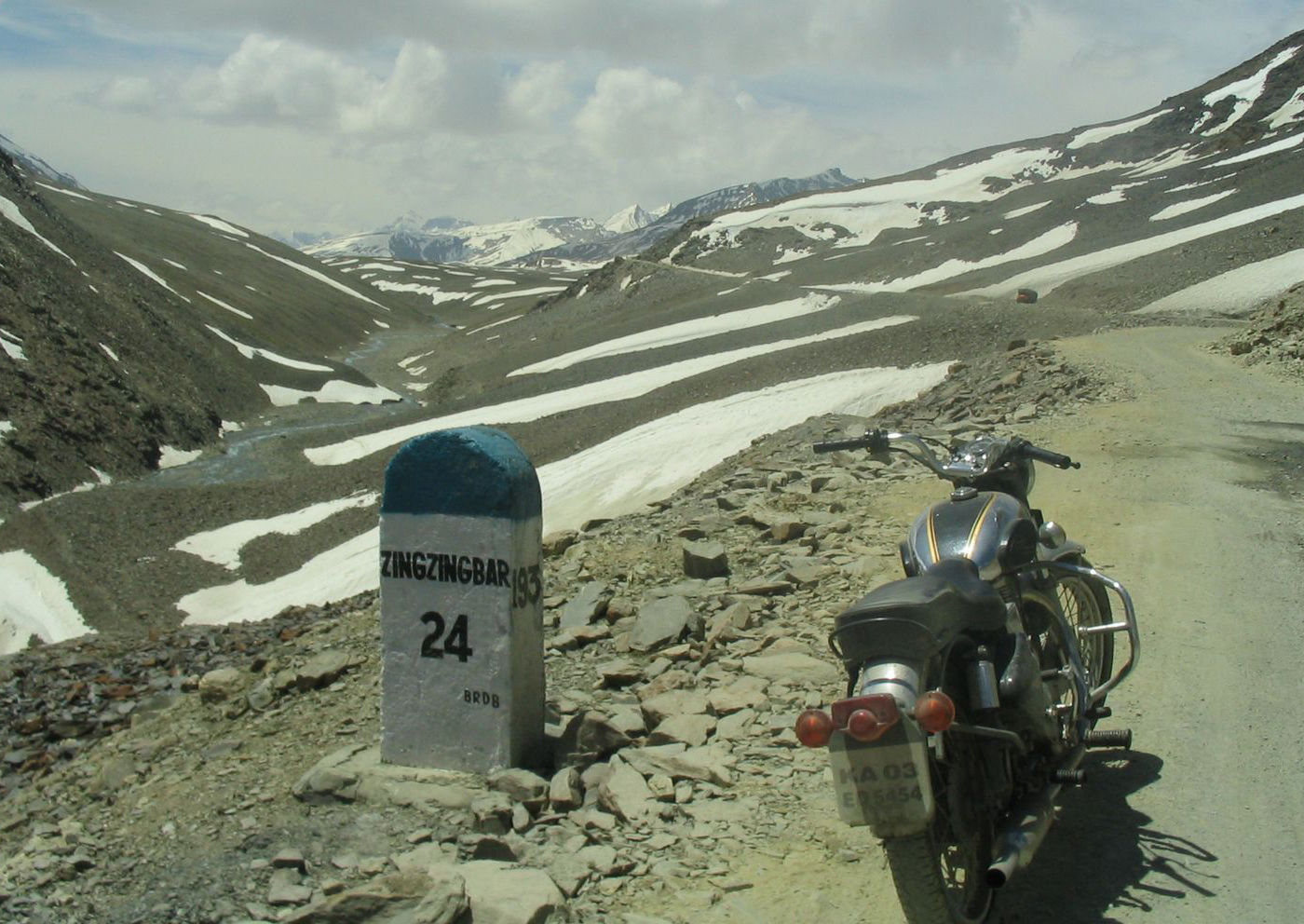
In the Himalayas, daytime temperatures at lower altitudes can be as high as 28ºC, though on average you're likely to be riding in a range of 12-15ºC. Sometimes, temperatures can fall to near-freezing over the highest passes, especially in the early mornings.
Geography
The highest motorable road in the world is here.
India is a whole sub-continent that was turned into a nation by a quirk of history.
Through historical and cultural ties, it once included Afghanistan, Pakistan, Nepal and Bangladesh. This sprawling landscape was full of kingdoms that alternately practised war and peace with each other.
India is the world's 7th largest country with an area of 3,287,590 sq km. Some of the highest mountains in the world are here, so are some of the coldest and the hottest places. The rainiest place in the world Cherapunjee in Assam, just lost that honour to another region close by. Adventure seekers will find it interesting that the highest motorable road in the world is in India, at Khardung La in Ladakh. Perched adventurously at 18,380 feet (5602 metres). This narrow strip of tarmac was painstakingly dug out of the mountains, it allows traffic to go only one way on any given day, and the other way on the next day.
Nearly every landscape you could think of exists in India. High plateaus, low plains, tropical rain forests, snowbound landscapes, deserts, coasts…dry and wet…crowded and desolate.
People And Religion
The world’s most religious Nation, that lets you practise your own.
India is a secular country, with a majority Hindu population. This, the world’s oldest living religion…or culture… as some argue, has within itself many forms of worship. The Hindu way ranges from sophisticated idol worship rich with ritual and chanting to simple Nature and ancestor worship.
The Hindu culture created Buddhism, Jainism, Sikhism, and allowed the spread of Christianity among the people, long before it made inroads into Europe. Ancient Hindu thought is believed to have strongly influenced other world religions. Even today, it is not unusual for Hindus to go to churches and mosques with reputations for miracles.
Ancient Sanskrit could even be called the world’s mother tongue, if you look at the number of languages it has spawned, both within and outside India. To illustrate with an interesting observation…the Sanskrit word ‘namah’ meaning ‘name’, is the root for the Hindi ‘naam’, the English ‘name’, the French ‘nom’, the German ‘namen’ and the Spanish ‘nombre’.
Hu Shih, the former Ambassador of China to USA believed that “India conquered and dominated China culturally for 20 centuries without ever having to send a single soldier across her border.” He must have been referring to phenomena like Buddhism, martial art, yoga, meditation, vasthu – possibly the mother of feng shui - and other forms of knowledge which made their way across the Himalayas into China, carried there by Indian holy men.
Many different invaders have come over the mountain passes to carry away India’s fabled wealth. Some of these conquerors even tried to destroy the culture, but it was like a fist trying to hit and hurt a river. The loosely knit Hindu culture accepts and integrates other influences rather easily. The Greeks, Mongols, Iranians, Afghans, British, French and Portuguese all left their influences on the looks, languages, customs and cuisines of India. India in turn touched their thoughts and cultures enriching them forever.
India has always given shelter to those escaping religious persecution. Zoroastrians (Parsis) from Iran, Jews who settled here centuries ago, and more recently the Tibetans including the Dalai Lama.
African tribals called Siddis live in Gujarat, they came to India as mercenaries. In the remote mountains of Himachal Pradesh live descendants of invading Greeks. Stragglers from Alexander’s army that was overthrown after he left India. Pockets of Indo-Greek influence still exist in many other parts of India. Few people know that the populations of 7 hilly states on the north-eastern border, close to China, are of the oriental race.
History
There’s more living history here, in the villages and towns, than in the museums elsewhere.
What the world calls mythology is in India, history. Every myth has left tell tale signs to challenge the skeptics who would appear many thousand years later.
You may not believe Lord Rama existed, but satellite imagery will show the bridge he built to reach Sri Lanka. Lord Krishna? Just another legend. But the story does say that when he died the sea rushed in to reclaim his capital. Scuba divers at Bet Dwaraka now explore what could have been his palace.
In India geography, mythology and history don’t disagree.
Time is relative here. The standard 5000 years that the world applies to most ‘ancient’ civilisations is in India, like recent history.
Except for the last few hundred years, India has always led the way in thought, and trade. A long list of concepts that are considered to be inventions of other nations, actually originated in India. From Arabic numerals and the concept of zero…to martial art.
Albert Einstein once said "We owe a lot to the Indians, who taught us how to count, without which no worthwhile scientific discovery could have been made."
There is talk of India becoming a superpower soon, the truth is it has already been there. But it preferred to lead with ideas and not armies.
In the 1700s India and China are said to have dominated world trade by over half. Colonisation brought an advanced and peaceful way of life to its knees.
India, as an autonomous state, has only existed since 1947. Before that, 'British India' covered India, Pakistan and Bangladesh.
Health
How to avoid the Delhi Belly.
Drink only packaged water. The eateries you visit with us are hygienic and tried and tested.
Our medics have a huge amount of experience in all fields and always carry a wide range of medicines to deal with tummy upsets – and any other malaise from which you might suffer.
In the Himalayas altitude sickness is a concern. We have a great deal of experience in preventing and dealing with it. We allow a suitable acclimatisation period for all groups and our medics carry oxygen and medication to alleviate symptoms should they arise.
For general advice on inoculations, talk to your GP.
Poverty
India’s wealth and poverty can both be shocking.
In the 20th Century, there was a time when the richest man in the world was the Nawab of Hyderabad. Today there are Indians in the list of 10 richest men in the world. And the Indian middle-class is being wooed by every foreign brand worth its salt.
But India is a land where extreme opposites co-exist. Poverty is a reality, though its extreme forms are found only in a few states like Bihar, Orissa and parts of Rajasthan.
Roads And Riding
From highways to no ways.
National and state highways are reasonably good. Other roads can have potholes, and speed breakers camouflaged to hide and jump out at you seconds before you hit it.
Animals and pedestrians will cross the road whenever and wherever they want. Expect the unexpected at all times. Other motorists may not signal their intention to brake or turn. Road signs are often conspicuous by their absence.
But you will return surprised by the speed of your reflexes, and your presence of mind.
Communication
English is considered an Indian language and is spoken like one.
Hindi is spoken by about a quarter of the population. English is spoken widely in the south, and less in the north. Though in the cities you may not have a problem understanding what is said, in the smaller towns and villages you may not recognise your mother tongue.
International telephones are easy to find and a few places in which we stop have internet access. It is also possible to source a pre-paid Indian SIM card for mobile phones, which will substantially reduce your bills over a fortnight.
Time
What time is it? Thursday.
In Goa, time travels in slow motion. It probably confuses India’s best scientists. IST or Indian Standard Time, is five-and-half hours ahead of GMT and four-and-a-half ahead of BST. Intriguingly, the word for 'yesterday'and 'tomorrow' is the same in Hindi. Time sort of works differently in India.
Money
Do bring some.
We will make sure you get the chance to change your spending money. In many places you'll also find cash-points. If you're going to change money back into your native currency on departure, then be sure to keep cash-point receipts and encashment certificates, as you'll be unable to do so without them.
Wildlife
The encyclopedia was written here.
India must be one of the few countries in the world which has both lions and tigers within its borders. There are still ecosystems where new species of plants and animals are being discovered.
On our southern tours you can expect to see birds, deer and even wild elephants from the bike. At some of our overnight stops, wildlife safaris can be arranged and you could spot tigers, leopards, bears and much more. In the Himalayas there is rich bird life, plus wild ass, blue mountain sheep and marmots.